what happens to most meteoroids when they enter earths atmosphere
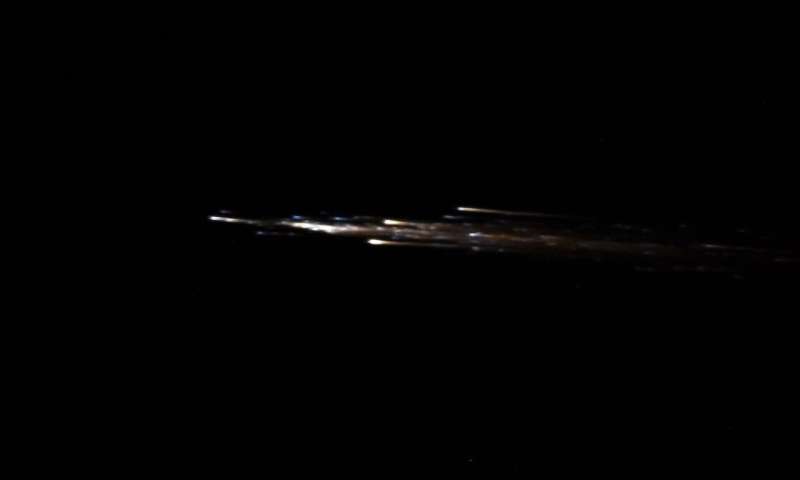
When one of the Russian Progress resupply ships undocks from the International Space Station, timing is everything. The Progress needs to burn down its engines at just the right fourth dimension to instigate the deorbit burn in order for the ship to enter the atmosphere at just the right place and so that its subversive re-entry occurs over the Pacific Ocean. That style, whatsoever potential surviving $.25 and pieces that might attain World volition hit far away from any country masses—which are home to people, buildings, and other things we don't want to become bonked.
Last week, the timing for the Progress MS-15 cargo ship was merely right, so that the astronauts/cosmonauts on board the ISS could encounter the transport every bit it broke autonomously and burned up in Earth's atmosphere. JAXA astronaut Soichi Noguchi shared the view on social media.
"Farewell, Progress 76P MS-fifteen! #Russian cargo spacecraft undocked from #ISS, and successfully burned up," Noguchi tweeted, sharing a photo of the Progress' peppery demise.
Farewell, Progress 76P MS-15! #Russian cargo spacecraft undocked from #ISS, and successfully burned up. #ロシア プログレス宇宙船、役目を終えて大気圏突入時の夜空に燃え尽きる瞬間を見事に捉えました!#はやぶさ 思い出すと泣けます。。。 picture.twitter.com/2OLMrlmAKO
— NOGUCHI, Soichi 野口 聡-(のぐち そういち) (@Astro_Soichi) February ix, 2021
Uncrewed Progress cargo ships have been flying since 1978, supporting previous Soviet-era space stations such every bit Salyut half-dozen, Salyut 7 and Mir. They have been bringing supplies to the ISS since the very beginning of operations.
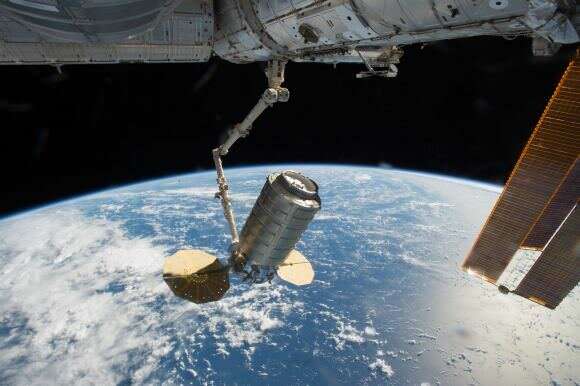
Merely now, there are several robotic, automatic resupply ships for the infinite station: the European Space Agency'due south Automatic Transfer Vehicle (ATV), JAXA's (Japan Aerospace Exploration Agency) HTV resupply transport, Northrop Grumman'south (formerly Orbital ATK) Cygnus cargo ship, and SpaceX's Cargo Dragon.
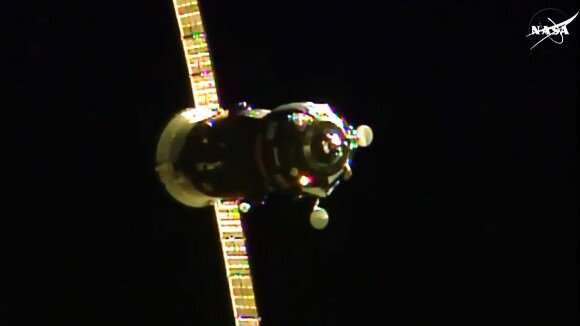
These ships bring supplies such as food, h2o, replacement/spare parts and experiments to the crew, equally well as propellants and oxygen. After everything is unloaded, ships similar Progress go a trash tin—a place to stow garbage and other unneeded items. The ships stay docked to the ISS for well-nigh six months, and afterwards being loaded with trash and waste, the hatch to the vehicle is closed and the Progress undocks from the station. Then the procedures for reentry brainstorm.
Progress is designed to burn upward in the atmosphere, but not everything is completely combustible. In a press release, Roscosmos said the non-combustible components of the craft land and sink into a "non-navigable region of the South Pacific. Non-combustible structure elements will driblet in the calculated expanse of the non-navigable region of the Pacific Body of water. The estimated fragments drib area is approximately one,680 km east of Wellington (New Zealand). Roscosmos has completed all the necessary procedures to flag this surface area equally temporarily dangerous for sea navigation and aircraft flights."
But besides the cargo ships returning from the ISS, other human-made objects regularly come across their demise by streaking through and burning up in Earth's atmosphere. Things like erstwhile, inactive satellites, rocket stages and other discarded hardware, likewise as smaller pieces of space debris—such as fragments of vehicles that exploded or collided, and even small pieces of paint that take come off of space vehicles—regularly burn upwardly in Earth's atmosphere.
All these items—both big and small—are tracked by radar by the Infinite Surveillance Network (SSN), which oversees radar and optical sensors at various sites around the world. At that place is the Joint Combined Infinite Operations Centre (CSpOC) at Vandenberg Air Force Base, role of U.Southward. Strategic Command and ESA's Space Debris team. They detect, track and place all objects in Earth orbit, besides equally monitoring the International Space Station (ISS) and other NASA satellites for potential collisions.
Interestingly, on boilerplate, virtually one satellite crashes back to Earth every week. Nearly are uncontrolled entries, and it's kind of a crap shoot as to where any pieces surviving pieces might autumn. Merely these peppery reentries are rarely seen, mostly because Earth is a large identify, mainly covered by water, and much of what falls ends up in plopping downwards into the oceans. Some other thing is, near of united states of america aren't looking up into the dark sky all that oftentimes.
But these reentries are seen at times—sometimes by video surveillance cameras or dashcams. If the satellite or old rocket piece is big enough, pieces can be seen shedding off as the reentering vehicle descends in a superheated shroud of incandescent plasma. The ablation process starts around a tiptop of 100 km and is usually complete past the fourth dimension the object has descended to virtually 20 km. (Here's additional info on space debris).
Of form, "naturally occurring" objects fall through our temper besides, space rocks that range in size from grit grains to modest asteroids. Many times, if you lot meet something steak beyond the night sky, it is difficult to tell the deviation between a meteor and a piece of disintegrating space debris.
And of course, for the spacecraft we DON'T want to have pause up in the temper—such as crewed spacecraft, or fifty-fifty small things like the render capsule for the Hayabusa 2 spacecraft—there are heat shields to protect them. But that's another story for another mean solar day.
Citation: This is what happens to spacecraft when they re-enter the Globe's temper (2021, Feb 17) retrieved 7 April 2022 from https://phys.org/news/2021-02-spacecraft-re-enter-earth-atmosphere.html
This certificate is subject to copyright. Autonomously from any fair dealing for the purpose of individual study or inquiry, no part may be reproduced without the written permission. The content is provided for information purposes merely.
Source: https://phys.org/news/2021-02-spacecraft-re-enter-earth-atmosphere.html
0 Response to "what happens to most meteoroids when they enter earths atmosphere"
Publicar un comentario