What Part of the Computer Is Responsible for Reading and Writing Data
Servers are the powerhouse backside every information center. These modular, boxy components contain all the processing power required to route and store data for every possible use case.
Depending on the size of the data center, organizations apply blade, rack or belfry servers and then admins can scale the number of servers depending on demand, finer maintain the hardware and easily keep them cool.
Whether a data center uses rack, bract or tower servers, the cardinal server hardware components stay the aforementioned and help back up simultaneous data processing at any scale. Here's a quick refresher on the basic components of a server and how they help get data from point A to indicate B.
1. Motherboard
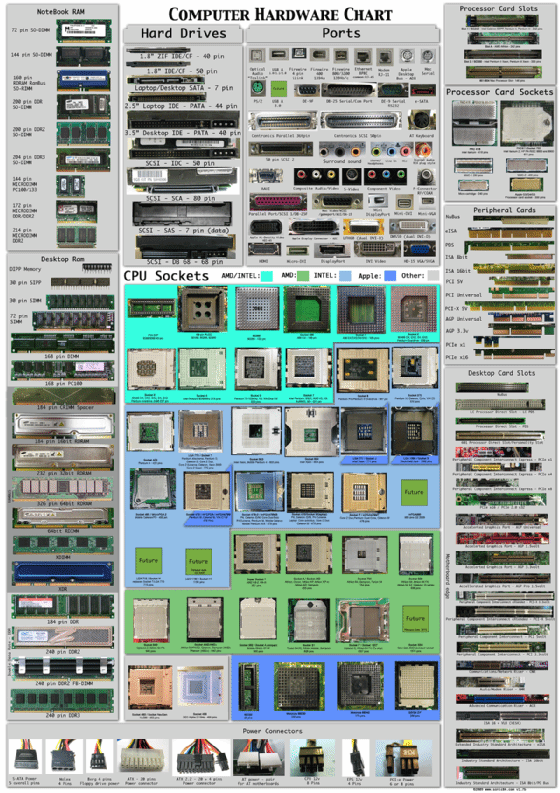
This slice of server hardware is the chief printed circuit board in a calculating system. As a minimum, the motherboard holds at to the lowest degree one primal processing unit (CPU), provides firmware (BIOS) and slots for memory modules, along with an assortment of secondary chips to handle I/O and processing support, such every bit a Serial Avant-garde Technology Attachment (SATA) or Serial-Attached SCSI (SAS) storage interface. It too functions as the fundamental connectedness for all externally continued devices and offers a serial of slots -- such as PCIe -- for an array of expansion devices, such as network or graphics adapters.
A standard motherboard blueprint includes six to 14 fiberglass layers, copper connecting traces and copper planes. These components support power distribution and signal isolation for smooth performance.
The two master motherboard types are Advanced Engineering Extended (ATX) and Depression-Profile Extension (LPX). ATX includes more space than older designs for I/O arrangements, expansion slots and local area network connections. The LPX motherboard has ports at the dorsum of the system.
For smaller form factors, in that location are the Balance Engineering science Extended, Pico BTX and Mini Information technology Extended motherboards.
2. Processor
The CPU -- or simply processor -- is a complex micro-circuitry device that serves equally the foundation of all estimator operations. It supports hundreds of possible commands hardwired into hundreds of millions of transistors to process depression-level software instructions -- microcode -- and data and derive a desired logical or mathematical result. The processor works closely with memory, which both holds the software instructions and information to be processed likewise as the results or output of those processor operations.
This circuitry translates and executes the basic functions that occur in a computing system: fetch, decode, execute and write dorsum. The iv main elements included on the processor are the arithmetics logic unit of measurement (ALU), floating bespeak unit of measurement (FPU), registers and enshroud memory.
On a more than granular level, the ALU executes all logic and arithmetic commands on the operands. The FPU is designed for coprocessing numbers faster than traditional microprocessor circuitry.
The terms fundamental processing unit and processor are often interchanged, fifty-fifty though the use of graphics processing units means at that place tin can sometimes be more than than one processor in a server.
three. Random access retention
RAM is the main blazon of retentiveness in a computing system. RAM holds the software instructions and information needed by the processor, along with any output from the processor, such as data to be moved to a storage device. Thus, RAM works very closely with the processor and must match the processor'southward incredible speed and performance. This kind of fast retentivity is usually termed dynamic RAM, and several DRAM variations are available for servers.
RAM is defined by its speed and volatility. RAM offers much faster for read/write performance than some other information storage types, and because it serves every bit a bridge between the OS, applications and hardware. RAM is also volatile and will lose its contents when power is removed from the calculator. Because RAM is intended for high-performance temporary storage, the reckoner requires permanent or non-volatile storage for applications and data when the system is turned off or restarted.
RAM fries are typically organized and built into modules that follow standardized form factors. This enables retention to be added to a server hands or replaced rapidly in the event of a memory failure. The nearly mutual class factor for DRAM is the dual in-line memory module, and DIMMs are available in countless capacities and performance characteristics. A typical server tin contain hundreds of gigabytes of retentiveness.
4. Hard deejay drive
This hardware is responsible for reading, writing and positioning of the hard disk, which is one technology for data storage on server hardware. Adult at IBM in 1953, the hard disk bulldoze (HDD) has evolved over time from the size of a fridge to the standard ii.5-inch and 3.v-inch course factors.
An HDD is an electromechanical device using a collection of stacked disk platters around a central spindle in a sealed chamber. These platters can spin up to 15,000 rotations per infinitesimal, and different motor heads command the read/write heads as they transcribe and interpret information to and from each platter -- converting electronic 1s and 0s into magnetic patterns on the actual platters and vice versa.
Because the magnetic patterns of 1s and 0s remain indefinitely on the platters once power is removed from the storage device, deejay drives have long been the fundamental non-volatile storage selection for all computers. Disk drives communicate with the server's motherboard using a standardized interface such equally SATA, SAS or iSCSI.
Information center servers also use solid-state drives (SSDs), which replace spinning magnetic platters with not-volatile rewritable memory in a standardized disk drive interface -- such as SATA or SAS. The result is a storage device with no moving parts bringing depression latency and high I/O for information-intensive use cases. SSDs are more expensive than difficult disks, and then organizations often use a mix of hard bulldoze and solid-state storage in their servers to come across the unique performance demands of different workload.
5. Network connection
Servers are intended for customer-server computing architectures and depend on at least ane network connection to maintain advice between the server and a information middle LAN. LAN technologies kickoff appeared in the 1970s including Cambridge Band, Ethernet, ARCNET and others -- though Ethernet is by far the dominant networking engineering science available today.
A network connexion is primarily defined by its engineering and bandwidth -- speed. Early Ethernet network adapters supported 100 Mbps speeds, though today's Ethernet adapters can easily back up 10 Gbps. Modern servers tin can easily back up multiple network connections to support multiple workloads -- such as multiple virtual machines -- or body multiple network adapters together to provide even greater bandwidth for enervating server workloads.
Networks evolved to handle communication between applications, but storage traffic -- reading and writing data between applications and storage devices -- tin demand significant bandwidth. Dedicated storage networks take such as Fibre Channel (FC), Fibre Aqueduct over Ethernet (FCoE), InfiniBand and other storage networks are available to connect servers to data center storage subsystems.
A server's network connection is created through the addition of a network adapter that tin exist included as a chip and physical port -- plug -- on the motherboard, as well as a divide network adapter plugged into an available motherboard expansion slot, such as a PCIe slot). A conventional network adapter and dedicated storage network adapters can exist on the same server simultaneously.
6. Power supply
All servers require power, and the work of converting Air conditioning utility power into the DC voltages required by a server's sensitive electronic devices is handled past the power supply (PS). The PS is typically an enclosed subsystem or associates -- box -- installed in the server'southward enclosure. AC is continued to the server from a power distribution unit (PDU) installed in the server rack. DC produced past the ability supply is then distributed to the motherboard, storage devices and other components in the server through an array of DC ability cables.
Power supplies are typically rated in terms of power in watts and a typical server can use anywhere from 200-500 Westward -- sometimes more than -- depending on the amount and composure of devices in the server. Much of that power is dissipated equally oestrus that must be ventilated from the server. Power supplies typically include at least 1 fan designed to pull rut from the server into the rack where the heated air can efficiently be removed from the rack and data center.
Because a power supply powers the entire server, the PS is a single signal of failure in the server. Organisation reliability tin can be improved by using high-quality power supplies, over-rated power supplies -- capable of providing more than power than the server actually needs -- and redundant power supplies where a fill-in power supply tin take over if the main power supply fails.
Progressive server designs forego internal power supplies in favor of DC supplied throughout the rack using a mutual DC power omnibus. A bract-mode server and chassis typically use this kind of approach, though more traditional server form factors are starting to use this design, which relies on a common power supply placed in the server rack or blade chassis.
seven. GPU
Graphics processing units (GPUs) have traditionally been the realm of personal computers, but servers are outset to use GPUs for complex and demanding mathematical operations needed with visualization, simulation and graphics-intensive workloads -- such as AutoCad. Similarly, the rise of virtual desktop infrastructure brings a need for graphics capabilities allocated to virtual desktop instances.
A GPU is a dedicated form of processor chip holding i or more graphics processing cores capable of sharing computational tasks driven past underlying graphics software. GPUs such as the NVIDIA M60 provide 4096 effective CUDA cores.
GPUs are frequently rated in terms of teraflops, which represent the GPU's ability to summate ane trillion floating-bespeak operations per second. When the GPU chip is incorporated onto a graphics adapter carte du jour, there are additional specifications, such as the number of frames-per-2nd and amount and blazon of dedicated graphics memory -- sometimes as high every bit 32 GB of GDDR6 memory -- separate from the server's memory.
Servers typically comprise GPUs through a graphics adapter card installed in one of the server'southward available expansion slots, such as a PCIe slot. The graphics adapter can demand up to 300 W of boosted power and requires a divide DC ability connection from the server's power supply. High power demands also produce significant heat, which requires the utilize of at least one cooling fan on the graphics adapter. The sheer size of a server-course graphics adapter can limit the number of expansion slots available on the server.
Source: https://www.techtarget.com/searchdatacenter/feature/Drill-down-to-basics-with-these-server-hardware-terms
0 Response to "What Part of the Computer Is Responsible for Reading and Writing Data"
Publicar un comentario